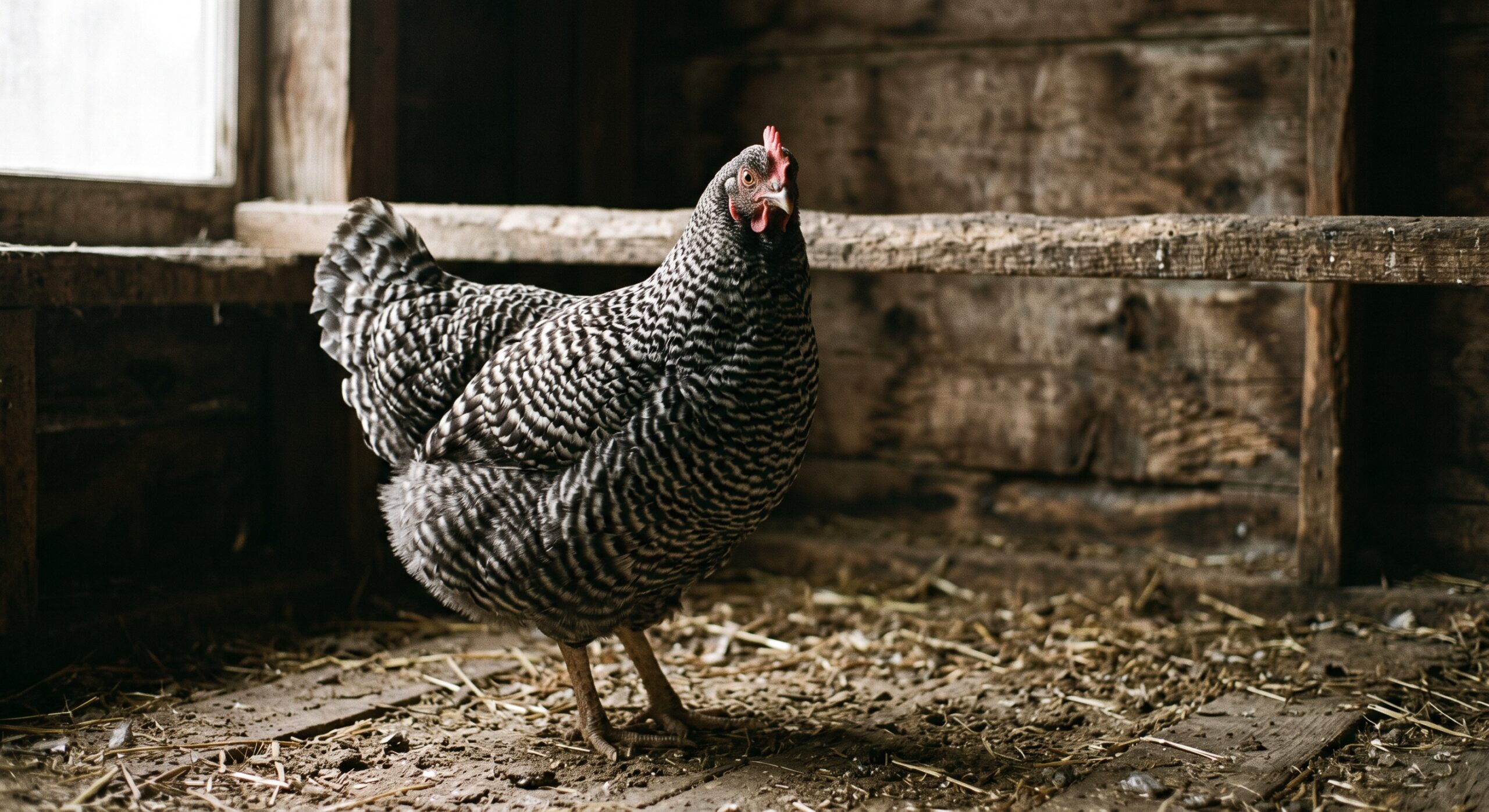
The bare patch showed up on the Barred Rock in the second week of September, and the man who found it did what nearly everybody does. He said molt, and he went back to the house.
It was a reasonable thing to say. September is the season for it. There were feathers scattered around the run and half the county was seeing the same in their own coops. Feather loss in chickens is common enough in the fall that the word molt gets applied to all of it without much examination, and most of the time nobody’s the worse for it.
This time it cost him until November.
September
What he had was a stretch of pink skin along her back, a hand’s width across, and a hen who’d gone quiet and stopped coming up to the fence with the others.
Molt is orderly, and that’s the thing worth knowing. Feathers come away with a clean edge, the way a shingle lifts, and underneath there’s already new growth started. Brush the good feathers back against the grain and the skin shows tiny gray straws pushing through, stiff and sheathed, and that’s a bird doing exactly what she’s meant to be doing. It runs eight to sixteen weeks. Most hens take it up around eighteen months old and keep to it once a year after.
He didn’t brush the feathers back. If he had, he’d have found nothing underneath but bare hide, some of it scabbed, and the loss around the edges ragged rather than clean, with broken shafts still stuck in the skin.
Ragged edges and no pinfeathers is not a molt. Something was taking those feathers off her.
Early October
Two more hens went bare across the shoulders, and it stopped looking like coincidence.
That’s the fork in the road, though nobody knows it at the time. One hen losing feathers, or two or three who all sit low in the pecking order, points at something social. The rooster. Bullying. A bird pulling her own out. When it starts moving through the flock, it points at something that spreads, and that means parasites or disease or a hole in the ration every bird is eating from.
He went out at two in the afternoon in good light, went over every bird he could catch, found nothing at all, and came away satisfied the coop was clean.
That’s the part that gets people. Red mites feed at night and spend the daylight tucked into the cracks in the roost bar and the coop wall. A careful inspection in the middle of the afternoon is a careful inspection of the wrong place at the wrong hour. Lice would have shown themselves, pale and rice-sized down at the feather base around the vent, with clusters of white eggs cemented to the shafts. Mites wouldn’t, and didn’t.
He had southern Missouri humidity working against him besides. Warm and damp runs a mite population up in a hurry, and a coop that came through a dry spring clean can be overrun by the end of August.
Late October
The Barred Rock stopped laying. Her comb went pale.
His neighbor came by for something else entirely, listened to the account of it, and asked whether he’d checked the roost. Not the birds. The roost.
So the two of them went out the next morning before the sun was well up, right after the flock had come off the bar, and ran a sheet of white paper along the underside of it. It came back streaked with red.
That’s the whole test. It takes a minute and a piece of paper, and it finds the thing a whole afternoon of handling birds will miss.
What It Took to Clear It
Birds and coop both, and that’s where the second mistake usually happens.
Treating the flock and leaving the housing alone means doing the entire job again in a fortnight, because the population that matters is living in the woodwork and not on the hens. Everything came out. Old bedding, cobwebs, the works. Poultry-safe dust on the birds and the same into every crack in the roost and the walls, then again on schedule to catch what hatched after.
He’d read somewhere about vinegar in a spray bottle. We’d not count on it.
November
Here’s the part he didn’t expect. The mites were gone by the end of October and the feathers weren’t back.
Feathers regrow on the bird’s own schedule and not the keeper’s, and a hen who loses them out of season may hold that bare patch until her next proper molt comes around. The Barred Rock went into the cold half naked and needed a draft-free corner and better feed than the rest of them to see December through.
Had that same hen been up in Wisconsin she’d have been in real trouble. Molt runs on daylight, and the farther north a flock sits the harder the light falls off in autumn, so the whole business comes on earlier and moves faster. A bare bird in November is a nuisance in Missouri. It’s a danger where winter shows up on time.
Which is worth sitting with. The mites cost him three weeks of looking in the wrong place, and the bird paid for it across a whole winter.
The Two He Found on the Way Through
There were two other things in that coop, and they account for most of what mites don’t.
His rooster had a favorite. She had bare skin on her back and her shoulders and the back of her head, in exactly the places a rooster grips while mating, and that isn’t sickness or cruelty but arithmetic. One rooster to ten or fifteen hens is about the ratio. He had one to eight. A hen saddle, a small canvas apron that sits over her back, kept her covered while she grew back in.
And there was a young hen at the bottom of the order with the feathers gone around her tail base and the skin broken, and the rest of them working at it, which is how that goes once blood shows. Some of it was crowding and boredom. Some of it was protein. A feather is mostly protein, and a flock running short will start eating each other’s, so when birds are pulling and swallowing feathers rather than just picking, the feeder is the first place to look and the behavior is the second.
What It Comes Down To
A few minutes with your hands in the feathers in September is worth more than anything that happens after.
The man with the Barred Rock knows it now. He looks at the edges of the loss and whether there’s anything coming in underneath. He counts how many birds are showing it. He notes where on the body the feathers are gone, because the location names the cause about as well as anything will. And once a year in the fall, before the sun’s up, he runs a piece of white paper along the underside of that roost bar.
She laid again in March.
A few questions folks ask
How do I know if my chicken is molting or has mites?
Molt leaves clean-edged loss with new pinfeathers coming in underneath. Mites leave ragged loss, broken shafts, and often red or scabbed skin. A sheet of white paper run along the roost at dawn settles it.
Why is my chicken losing feathers on her back?
Usually the rooster. He grips her back and head while mating, and a favored hen wears bare in those spots. A hen saddle protects her while the feathers come back.
How long does a chicken molt last?
Eight to sixteen weeks, generally starting in fall once a bird is around eighteen months old.
Will feathers grow back after mites?
Yes, but often not until her next molt. A hen who loses feathers out of season may carry the bare patch for months.
A note on this series
Harmony Hills Ventures publishes these posts as general information for rural landowners. They are not veterinary, agronomic, engineering, or legal advice, and no post can account for the conditions on a particular place. Land, livestock, water, and weather differ from one county to the next and from one year to the next. Before you act on anything you read here, talk it over with your veterinarian, your county extension office, or another qualified professional who can look at your own ground.