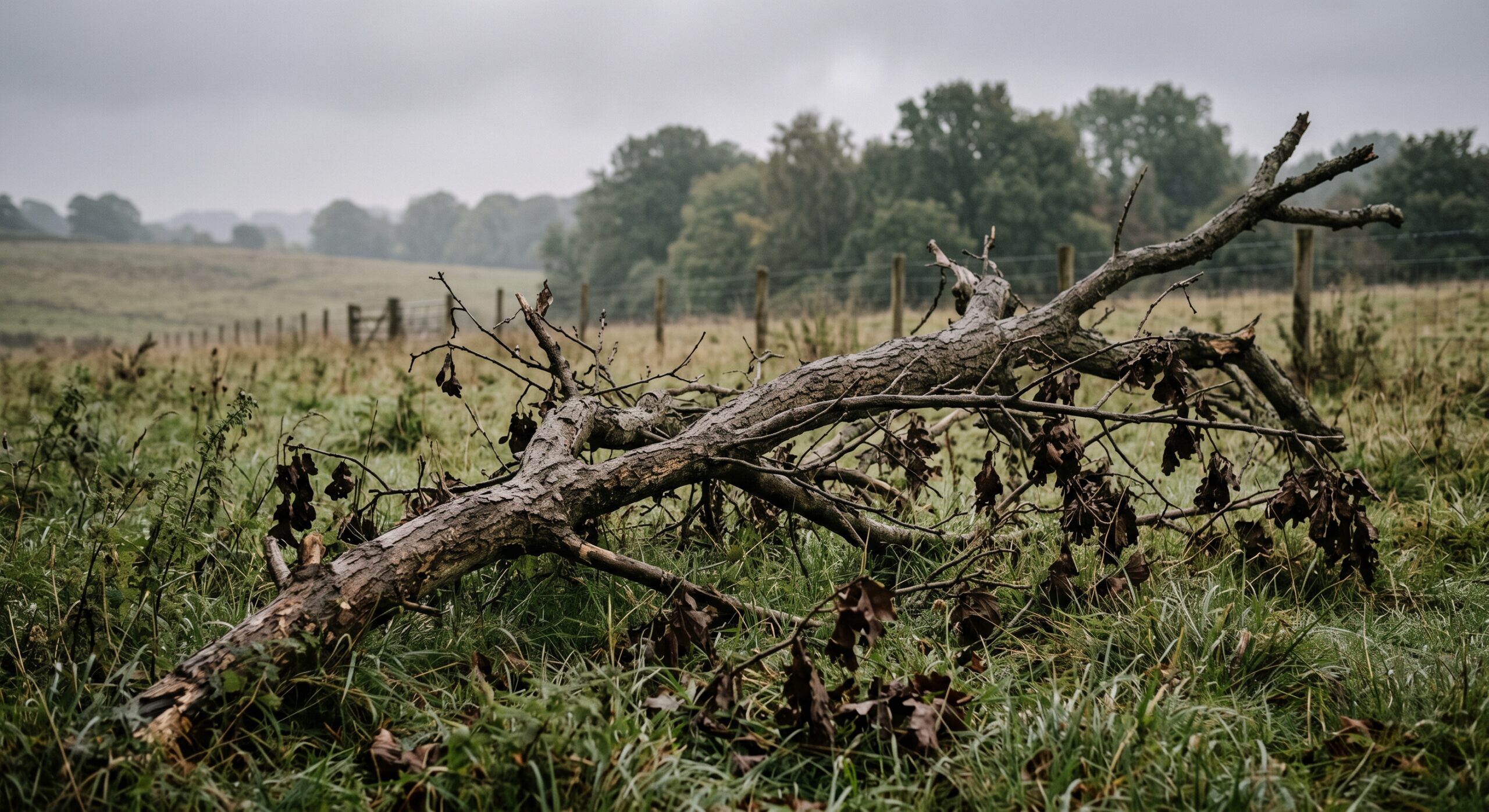
The storm came through around eleven at night and by seven the next morning there was a cow dead in the north pasture, forty feet from a limb that hadn’t been there the day before.
Nothing about her looked like an illness. She’d been sound at evening feed. There was no scour, no bloat worth noting, no sign she’d been down long. The limb was black cherry, torn off high and dropped whole, and the leaves on it had been stripped nearly bare on the side she could reach.
Most trouble with poisonous pasture plants for livestock takes weeks to show. This one took about an hour.
What Came Off the Tree
A black cherry leaf on a living branch is not much of a threat. Cattle walk under those trees their whole lives.
What changes it is damage. The leaf holds two things in separate compartments, and as long as the wall between them stays up, nothing happens. Break the leaf, wilt it, frost it, chew it, and the two come together and make hydrogen cyanide. Prussic acid, the old hands call it. A ruminant’s stomach is close to the ideal place to release it, which is why cattle and sheep go down and a dog walking the same pasture doesn’t.
The amounts are small enough to be worth stating plainly. Something on the order of two to five pounds of wilted leaves can kill a twelve-hundred-pound cow. For a sheep it’s a fraction of a pound. A single limb carries many times that.
Two details about it are worth more than the rest.
The first is that the poison has a clock on it. Green leaves on the tree are one thing, wilted leaves are the dangerous thing, and leaves that have gone fully dry and brown are largely spent. The window runs a day or two after the limb comes down. Which means a man who walks his pastures the morning after a blow has done nearly all of the work there is to do.
The second runs against intuition. The dose doesn’t stack the way most poisons do. An animal can take in less than a lethal amount several times in a day and come through it, because the rumen clears the cyanide between meals. What kills is one large helping in one sitting. That’s exactly what a fresh-fallen limb offers, and it’s why the limb is worse than the tree ever was.
What He Did Next
He buried the cow and then he sprayed the place fence to fence.
That’s the part of this we’d want to slow down on, because it’s the common ending and it costs more than most folks reckon. A man who has just lost an animal to a plant will kill every plant he doesn’t recognize, and the cherry tree that did it was still standing at the fence line when he finished.
There’s a sorting worth doing first. Three piles.
The Ones That Will Actually Kill Something
The list is shorter than a nervous man expects, and it’s regional.
Poison hemlock and water hemlock take the wet ground, the ditch banks and the creek edges, and they green up early enough in spring to look inviting when nothing else does. Poison hemlock carries purple-blotched stems and finely cut leaves, and it holds its toxicity in hay for years, which puts it in a class of its own. Water hemlock is worse still. The first sign is often a dead animal.
The nitrate accumulators are a different animal altogether, because the plant isn’t the problem, the weather is. Pigweed, lambsquarters, johnsongrass, and sorghum-sudangrass will pull nitrate up to dangerous levels under drought or after a heavy nitrogen application. Up in Minnesota, nitrate is the leading cause of cattle poisoning outright. The same plant that’s fine in June can be lethal in a dry August, and no amount of looking at it will tell you which.
Perilla mint is the southern one. Square stem, coarsely toothed leaves, purple on the underside, and it smells like mint when you crush it. It grows in the shade at field edges and around barns, and cattle turn to it in the fall when the good forage has gone. It puts fluid in the lungs and an animal can die in a day or in a few hours.
And wild cherry, which is the one that started this, and which nearly every fence row in the eastern half of the country has in it somewhere.
The Ones That Don’t Matter
A good deal of what gets sprayed was never going to hurt anything. It’s ugly, it’s taking up room where grass could be, and it costs a man some yield. That’s a real complaint and it isn’t a poisoning complaint, and treating the two the same way is how a pasture ends up bare.
There’s a harder truth under it. If a pasture has enough to eat, stock generally walk past what they shouldn’t have. Nearly every poisoning story starts with an animal that ran out of options. Overgrazed ground, a drought, a lot with the grass eaten into the dirt. The weed profile in a pasture reads like a record of how it’s been kept, and thin ground grows different trouble than rested ground does.
The Ones That Are Feed
This is the pile most people don’t know exists.
Work out of Missouri put common pasture weeds against the grass growing beside them and found several of them running as high or higher on protein and digestibility. Dandelion is one. Chicory is another, and there are varieties bred and sold as forage. Narrowleaf plantain belongs in there too. Those three carry copper and zinc, which are short in nearly every hay bale in the country.
Two cautions come with it. The value falls off fast as the plant matures, so a weed that was feed in May is a stem in August. And protein content is not a safety test. Some of the weeds that came back high on that same list are toxic. Cocklebur is nutritious and will kill a young animal. The number doesn’t tell you what the plant is.
Mowing before things go to seed does most of what spraying does, without taking the useful plants down with the rest.
What It Came Down To
The pasture came back thin the next year, the way sprayed ground does, and thin ground is where this whole story starts.
He walks it now after a storm. It takes twenty minutes on a place that size and it’s the single most useful thing he does all summer. Room helps here, the way it usually does. On bigger ground the tree line sits well off the grazing and a fallen limb lands where nothing can reach it. On a small place the fence row is the pasture edge, and every cherry tree in it is standing over the feed.
He kept the tree. It’s a good tree, and it was never the problem. The problem was the wind and one night’s worth of not knowing.
A few questions folks ask
What are the most dangerous poisonous pasture plants for livestock?
Poison hemlock and water hemlock on wet ground, wilted wild cherry leaves after a storm or frost, perilla mint through the southern states in fall, and nitrate accumulators like pigweed and johnsongrass during drought. What’s dangerous depends heavily on region and season.
Why are wilted cherry leaves poisonous when the tree isn’t?
Damage releases the poison. Wilting, frost, or chewing breaks down the barrier inside the leaf and hydrogen cyanide forms. Fresh leaves on the tree and fully dried brown leaves are both far less dangerous than wilted ones.
Should I spray my pasture after losing an animal to a plant?
Identify what did it first. Broad spraying kills useful forage along with the culprit and leaves thin ground, and thin ground is what pushes stock to eat what they’d normally avoid.
Are pasture weeds ever good for livestock?
Some are. Dandelion, chicory, and narrowleaf plantain compare well with pasture grass on protein and carry copper and zinc that most hay lacks. Nutritional value is not a safety test, though, since several toxic plants also test high.
A note on this series
Harmony Hills Ventures publishes these posts as general information for rural landowners. They are not veterinary, agronomic, engineering, or legal advice, and no post can account for the conditions on a particular place. Land, livestock, water, and weather differ from one county to the next and from one year to the next. Before you act on anything you read here, talk it over with your veterinarian, your county extension office, or another qualified professional who can look at your own ground.