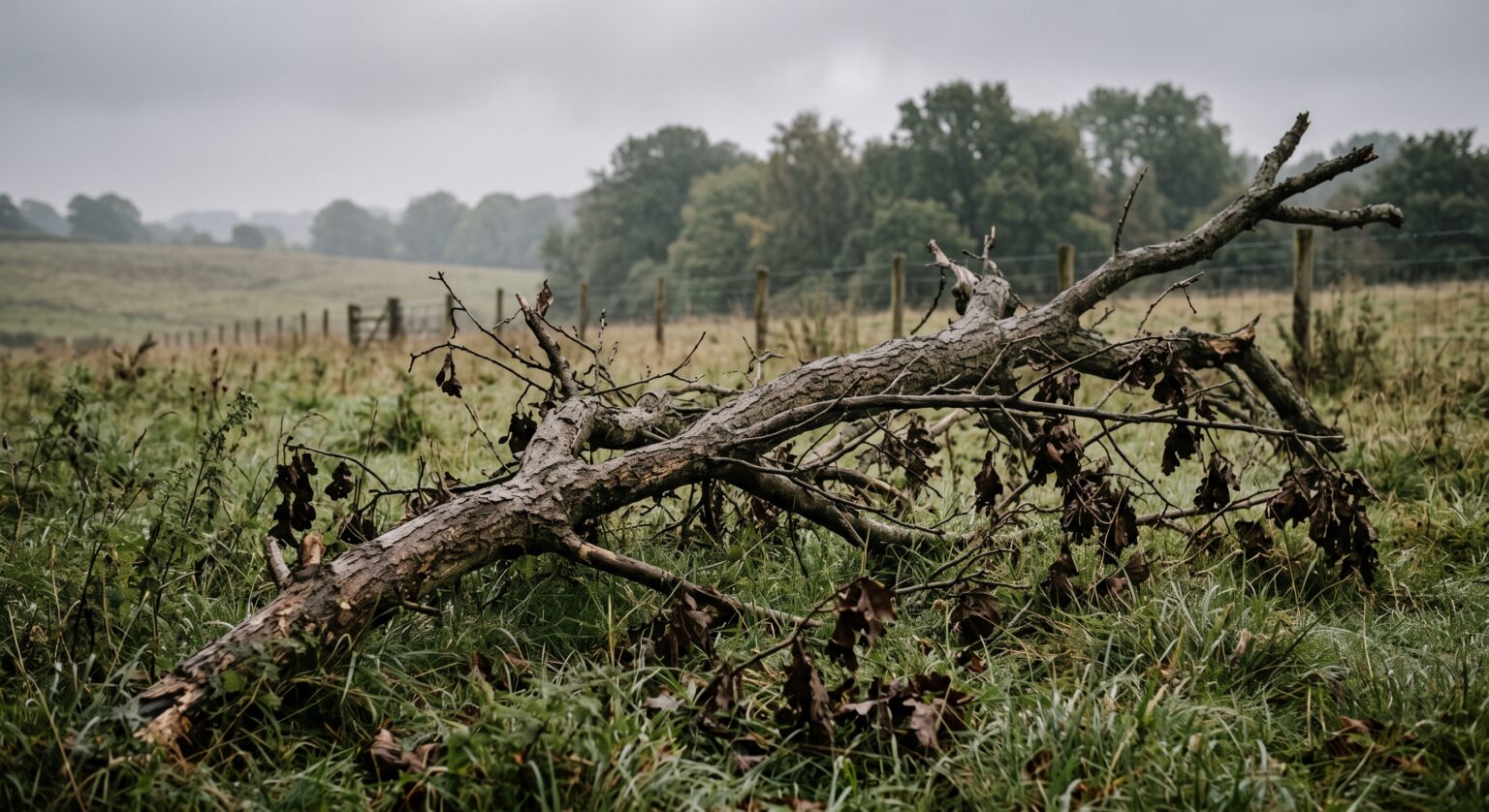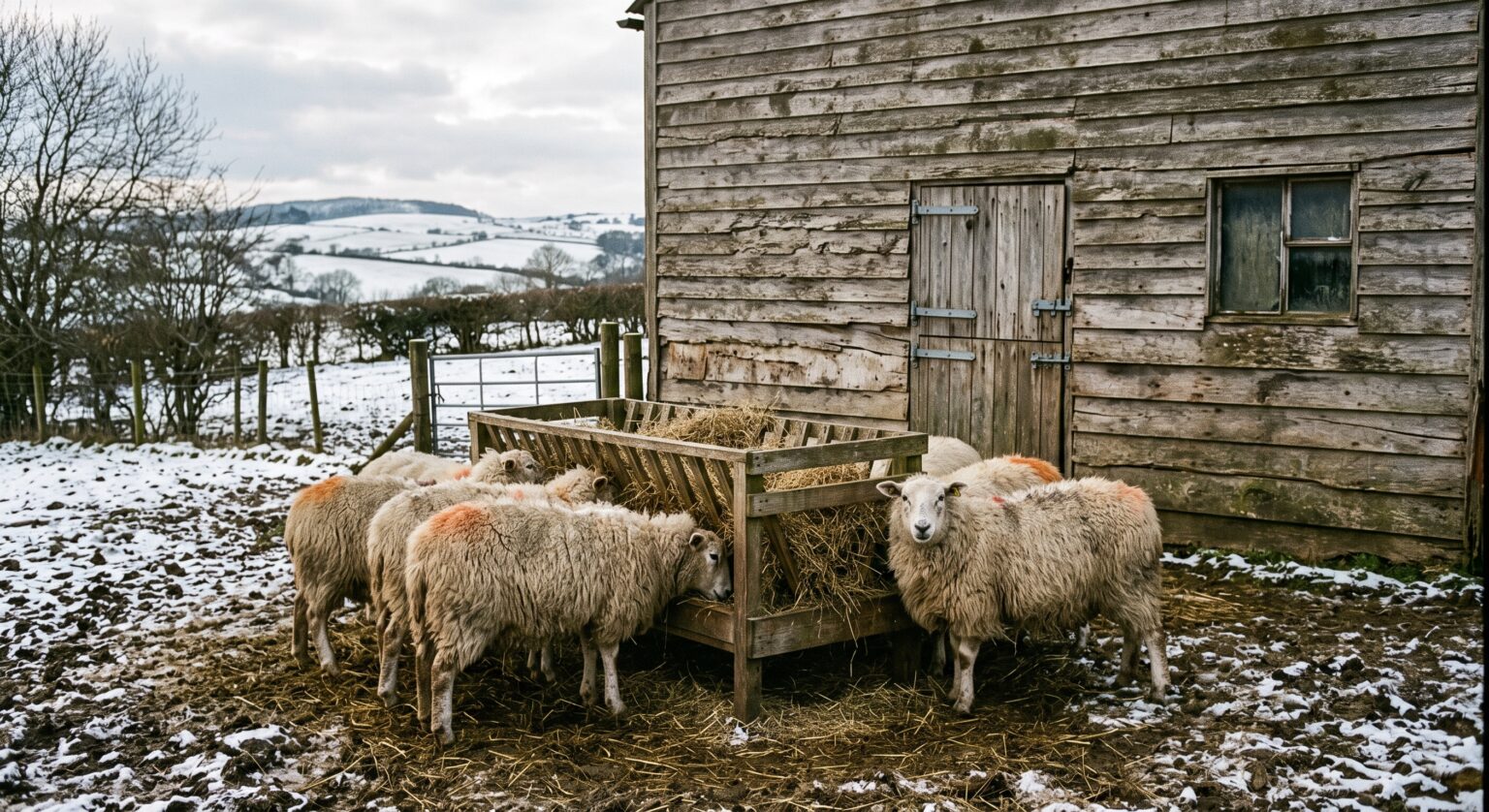
The corner had gone uncut for eleven years, and in July of a dry summer it got cut.
That’s how it usually starts. The rain quit in June, the second cutting came up thin, and a man standing at a gate in a short year runs the same arithmetic every hayman runs. There was ground he wasn’t using. A low back corner along the fence line, three acres of it, wet most springs and rough enough that the mower had always found a reason to turn before it got there.
He never asked whether milkweed is poisonous to livestock. He’d have told you he had no cause to. The question got asked for him in January, by four bales sitting at the end of a row.
What Was Growing in the Corner
He walked it before he cut it, which is more than a lot of folks do, and he came away uneasy without being able to say why.
There was a plant out there in colonies. Three feet tall, white flowers gone over, pods coming on. He broke a stem and it ran milk. He knew what that meant in a general way and not in a particular one, and that’s where most people are.
Two plants run milk in a fence row like that one, and they are not the same plant.
Common milkweed comes up on a single stout stem that doesn’t branch, hairy if you run a thumb up it, with pods that stand upright and come to a point like a teardrop. Hemp dogbane branches out about halfway, the stem goes smooth and takes a red cast as the season runs on, and the pods hang down in slender pairs, four to eight inches, curved like a sickle. Early in the year the two will fool anybody. By August they’ve told on themselves.
What he had was milkweed. Had it been dogbane he’d have had a worse problem and a plainer one, because dogbane carries the same kind of poison, holds it dried the same way, is harder to kill, and does nothing for anybody on its way through.
Is Milkweed Poisonous to Livestock, and How Much It Takes
It is, and it takes less than most folks would guess.
Milkweed carries cardiac glycosides, which do what the name says. They work on the heart. A hard dose brings labored breathing, a weak fast pulse, tremors, staggering. Death happens and it isn’t the usual outcome. What’s usual is an animal that goes off feed, does poorly through a stretch of winter, and costs a man a season of gain that never gets traced back to a bale.
Species matters a great deal here. Common milkweed and swamp milkweed, the two most people picture, sit at the low to middling end. Whorled milkweed and the narrowleaf kinds are the dangerous ones, and they’re small and thin-leaved and easy to walk past without a second look. Out through Kansas and Oklahoma the most abundant milkweed on the range is green antelopehorn, which runs moderate to high. So a man’s risk turns on which milkweed came up in his corner, and a good many men have no idea which one that is.
Cutting and curing doesn’t help. The toxin holds in the dried plant, and it takes a good deal less of it dried than green.
There’s been a comfortable rule about all this for a long time. Stock won’t touch milkweed unless the pasture’s bare, so keep grass in front of them and you’re fine. There’s real truth in that. It’s also thinner than it used to be. Range work in recent years has found cattle taking milkweed about as readily as they take grass, which is not what anybody expected and not what the old rule assumed. We’d keep the rule and stop leaning our whole weight on it.
Why a Bale Is Different From a Pasture
A cow in a pasture is choosing all day long. She’s got the run of the place and a whole menu in front of her and she can walk past what she doesn’t care for, and mostly she does.
A cow at a feeder in February is choosing nothing. What’s in the bale is supper. She can’t sort one stem out of a hundred pounds of packed dry hay and she’s got no reason to try, because the whole of it smells like the same thing.
That’s the difference that matters, and it’s why the honest answer to whether milkweed is poisonous to livestock starts with a question of its own. Growing where? The plant standing in a ditch bank is a wildflower. The same plant cut and baled and stacked is feed.
Five Months of Nothing
The bales came off the corner in the third week of July and went into the stack behind the barn.
Four of them, and he’d set them at the end of the row on purpose, because the doubt he’d had walking that ground didn’t leave when the mower did. He meant to look the plant up. Then August arrived with everything August brings, and he didn’t.
That isn’t carelessness. That’s a summer.
January
He was feeding on a cold gray morning, came to the end of the row, and the doubt came back with the bale.
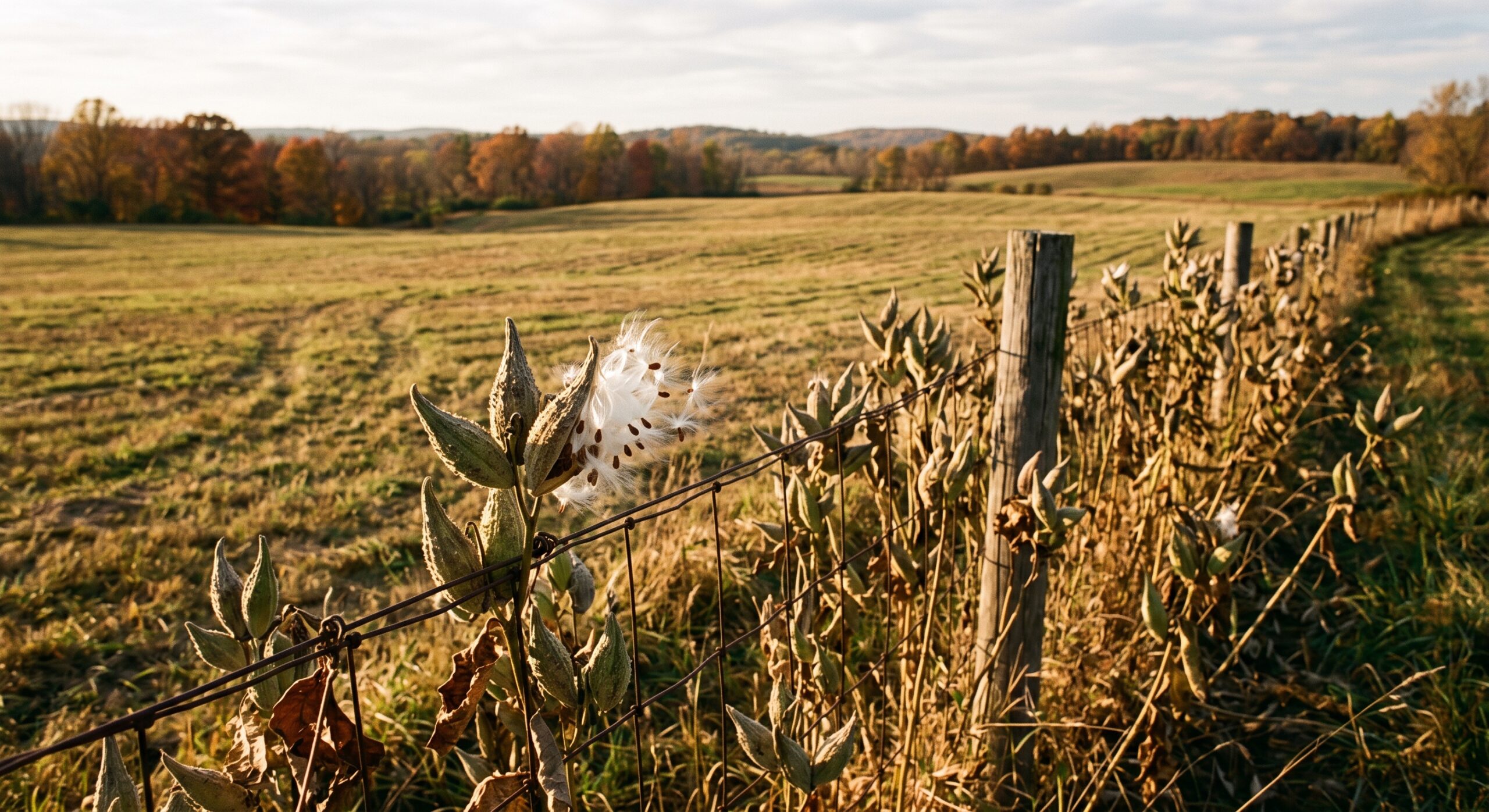
So he broke it open before he carried it out. Down in the middle of it, cured and gray-brown and perfectly intact, were the pods. Upright teardrops, split along the seam, the silk still packed inside.
He set those four aside and fed off the other end of the stack, and nothing came of any of it. Which is how the good version of this goes, and it’s the more common version, because a man who has a doubt in July and honors it in January generally keeps his cattle.
The Corner He Left Standing
Here’s the part that surprised him. He didn’t spray it.
He went back to cutting what he’d cut for eleven years and left the low corner alone, the same as he’d always done, except now he had a reason for it.
Every monarch butterfly east of the Rockies spends the winter in one small stand of Mexican mountain forest, and the whole population gets measured in acres. Last winter it came to about seven and a quarter, up better than half over the year before and still short of what the people who count them reckon is needed for the thing to hold. West of the Rockies is a separate population and a harder story. Around twelve thousand butterflies counted across two hundred and forty-nine wintering sites this past season, third lowest since the counting started in 1997.
They lay on milkweed and nothing else. There’s no second plant that will do.
So the corner earns its keep. It earns it as long as somebody is minding where it stops.
That’s the part that gets left out when a man is told to leave a strip for the butterflies. Milkweed doesn’t hold still. It runs on creeping roots and it widens a little every year, and come fall the silk that makes those pods worth looking at carries seed a considerable distance on a wind. A colony nobody watches doesn’t stay a colony in a corner. It becomes a colony in a corner and a scatter of plants forty yards into the hay, and the man who finds those is generally finding them the way this one did, in January, out of a bale.
Minding it isn’t much. Walk the edge once a year and see whether it sits where it sat. Mow the strip between it and the good hay before the pods open, which costs one pass. Keep it out of the lot and the paddock and the lane altogether, and that one isn’t negotiable, because an animal shut in a small space is in the same fix as a cow at a feeder. She isn’t choosing. Whatever’s in reach is what there is.
And keep grass in front of stock, which is the whole of the old rule and is easy to say in a good year. The trouble is that the year it stops being easy is the dry one. A short pasture and a hungry cow is the exact set of conditions this story opened with, and a man who’s grazing hard in August is a man who ought to know what’s standing along his fence lines.
And that’s the argument for room. On a small place the hayfield and the fence row and the pasture are all shoved up against one another, and a man is choosing one thing at the cost of another. On bigger ground he isn’t. The ditch bank, the timber edge, the wet corner the mower has always turned before, the strip along the county road. None of that is ground anybody was going to make hay off, and all of it will grow milkweed without asking. The plant lives where the mower doesn’t go, which is most of what a place is, if a man counts it honestly.
He keeps a note in the truck now with the two plants written out, stem and pod, so he can settle it standing in the field instead of five months later at a feeder.
The field still gets cut. The corner doesn’t, and he walks it every August to make sure that’s still a decision and not just a habit.
A few questions folks ask
Is milkweed poisonous to livestock?
Yes. It carries cardiac glycosides that affect the heart, and toxicity varies by species. Common and swamp milkweed are on the lower end. Whorled and narrowleaf milkweeds are considerably more dangerous. Drying does not remove the toxin.
Can you feed hay that has milkweed in it?
No. Hay is where nearly all the poisoning happens, because an animal at a feeder can’t sort the plant out the way she can in a pasture. Bales cut from an infested field are the risk, including purchased hay.
Will milkweed spread if I leave it in a fence row?
Yes. It spreads by creeping roots and by wind-carried seed, so a stand left alone widens and puts seed into nearby ground. Leaving a strip for pollinators works, but it means watching the edge and keeping the plant out of hayfields, lots, and paddocks rather than letting it go where it likes.
How do you tell milkweed from hemp dogbane?
Milkweed has one stout unbranched stem, often hairy, with upright pointed pods. Dogbane branches partway up, has a smooth stem that reddens through the season, and hangs slender curved pods in pairs. Both run milky sap and both are toxic.
A note on this series
Harmony Hills Ventures publishes these posts as general information for rural landowners. They are not veterinary, agronomic, engineering, or legal advice, and no post can account for the conditions on a particular place. Land, livestock, water, and weather differ from one county to the next and from one year to the next. Before you act on anything you read here, talk it over with your veterinarian, your county extension office, or another qualified professional who can look at your own ground.