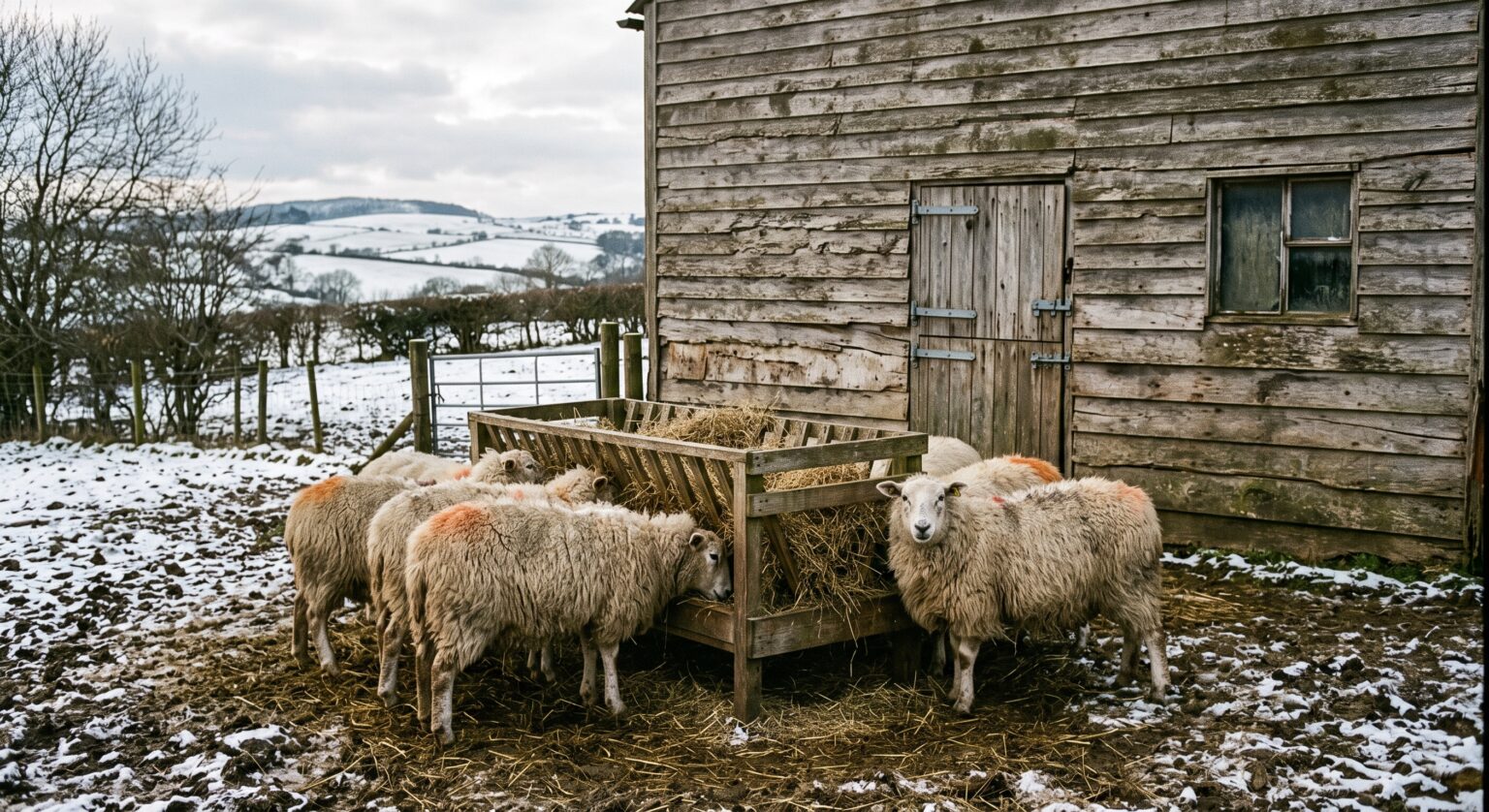
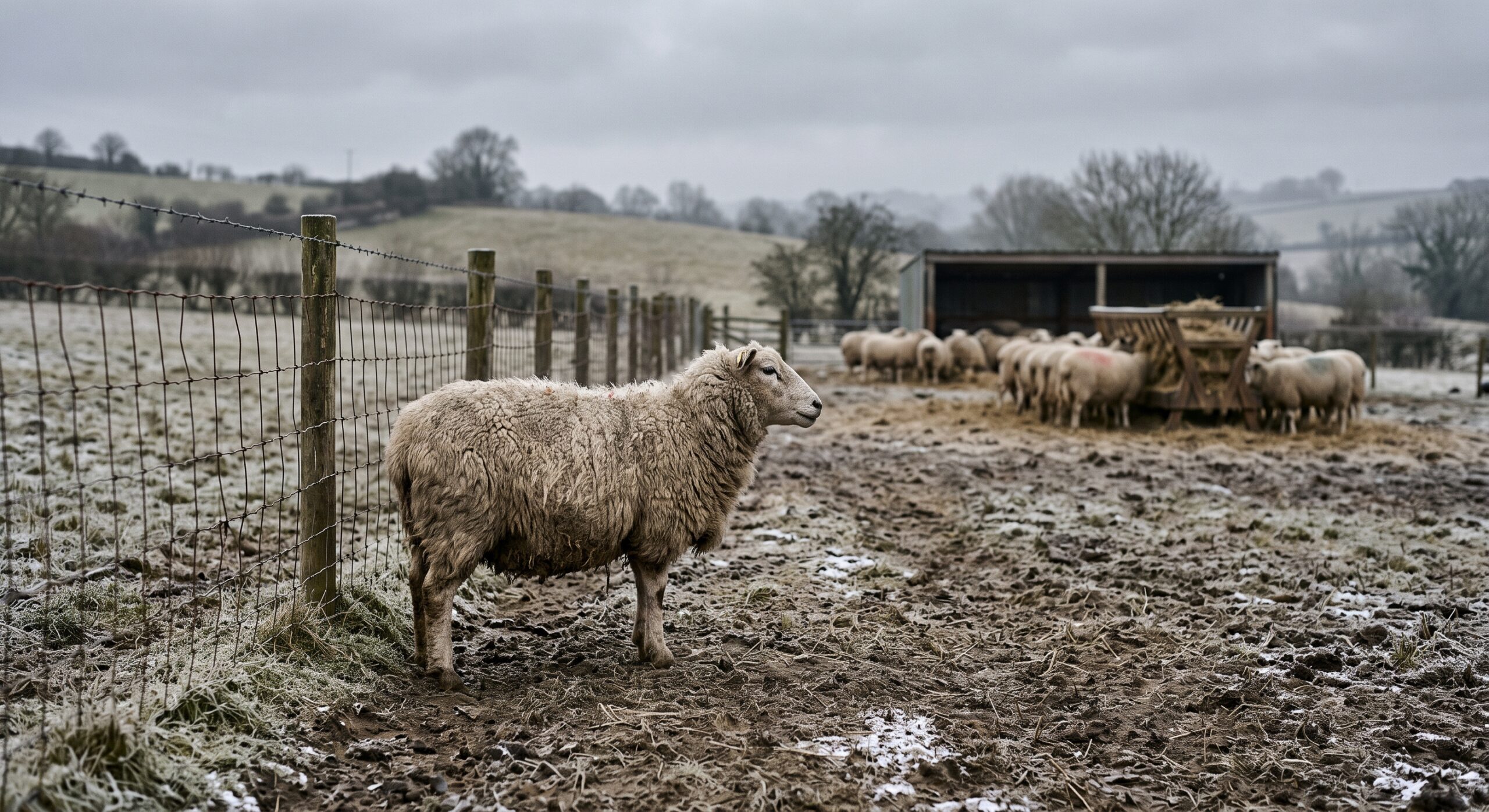
She was standing with her forehead against the fence at twenty to seven in the morning, and she didn’t turn when the feed hit the trough.
The rest of them did. Twenty-four ewes at the bunk and one at the wire, a big Suffolk cross carrying twins, three days from her date by his count. He walked over and put a hand on her and she leaned into the fence a little harder, and that was all the answer he got.
He called the vet from the lot. Then he had forty minutes with nothing to do but stand there and think about the sheep feeding schedule he didn’t have, which is how most men come to have one.
What She Looked Like
Head low. A tremor along the flank he could see when he got the light right. Eyes dull. She’d been slow at feed for three or four days and he’d put it down to being heavy. When he pressed on her she groaned, and there was a sweetness on her breath he couldn’t place and later learned to.
He didn’t know what he was looking at. He knew it was the ewe he’d have picked as the best on the place in October.
What He’d Skipped in October
Standing there, he went backward through it, and October was where it started.
The ewes had come off a dry summer thin, and he’d meant to put them on the bottom pasture for a couple of weeks before the ram went in. He hadn’t. It was the cheapest thing in the whole year and he’d skipped it for no reason he could name now.
A ewe on a rising plane of feed going into breeding drops more eggs. Two weeks of better grass ahead of the ram, or half a pound of grain a day, and the lamb count comes up. It works best on mature ewes and best of all on thin ones, and he’d had a pen full of thin ones.
The ewe against the fence had caught twins anyway. He’d been pleased about that.
The Sheep Feeding Schedule He Did Have
Through November and December he’d fed hay and left them alone, and that part was right.
A lamb builds slowly at first. A bred ewe through the early months asks barely more than an empty one, and average hay and water and mineral will carry her. He’d fed average hay. What he hadn’t done was notice they were still thin, and that this was the last stretch of the year where thin could be fixed for the price of feed.
He’d also opened the good hay first. It was on the front of the stack and it was easier to get to.
February
By the second week of February the good hay was gone and he was into what he’d put up late the summer before. Stemmy. Coarse. Cut a month past when it should have been.
The ewes were six weeks out. That’s the window where most of a lamb gets built, and the requirements go nearly straight up. The part nobody had told him is that her capacity goes the other direction at the same time. Two lambs take up room. There’s less space inside her in February than there was in December, and a ewe who could have eaten poor hay all winter and done fine physically can’t get enough of it down now to keep up.
So the answer in those weeks is better feed, not more feed, and he’d had the opposite.
He’d seen them slowing. He’d put out more of the same hay, which was the reasonable thing and did almost nothing, because how much was in front of them was never the problem.
Forty minutes of that, and then the truck came up the lane.
What the Vet Said
Pregnancy toxemia. What happens when a ewe short on energy in the last weeks starts breaking down her own body faster than she can handle the results. It comes on in exactly this window, in exactly this kind of ewe, for exactly this reason, and the sweetness on her breath was the smell of it.
There’s a companion trouble that arrives around the same time. That one is calcium rather than energy and it’ll put a ewe down looking much the same. Both are emergencies. Both get prevented in January, not treated in March.
The vet did what could be done. She lost both lambs that afternoon and he kept her, and she was a long while coming back.
Then the vet stood in the lot with him for a minute and said the part worth the whole visit.
Lambing was a week out for the rest of the flock, and after it came the highest bill of the year. Six to eight weeks of milk, above even what late pregnancy asked, peaking around the third or fourth week. A ewe raising twins gives a good deal more than one raising a single and eats accordingly. Feed them well.
And one thing more. If the water goes off, or the feed runs short, even for two days in that stretch, her milk drops and it does not come back. Not that lactation. Whatever she gives up she gives up for good, and it won’t show until weaning, when the lambs come in light and nobody connects it to a week in April.
He’d have told you that morning that he’d have remembered it without being told. We’d not be so sure. It’s the sort of thing a man remembers because a vet said it standing over a ewe he’d nearly lost.
What the Ground Had Been Telling Him
After the truck left he stayed in the lot and looked at the pasture, and it was the first time he’d looked at it as the problem.
Two calendars run on a place and they don’t line up. The grass floods in May, slows through the heat, comes back some in the fall, and gives nothing at all from December into March. The ewe’s hardest six weeks land square in the middle of that nothing.
Which meant the feed bill had never really been about acreage. He had grass enough in May for twice the flock, and he’d bought hay every winter anyway, because what governs a place isn’t the month it’s at its best. It’s the months it quits.
He stopped asking how many head the ground would carry. He started asking how many months it carried anything, and what the rest cost him, and that turned out to be the whole business. Some of the gap closed once he quit turning the flock out on the entire place at once. More of it closed when he started leaving a paddock ungrazed through the fall to feed off in December.
He drove to town that afternoon and bought better hay for the last week. It was late. It was also the first thing he’d done all year on the right day.
A few questions folks ask
What does a sheep feeding schedule look like through the year?
Roughly five stretches. Better feed for two weeks before breeding and a few weeks into it, maintenance through early gestation, a real step up for the last four to six weeks before lambing, the heaviest feeding of the year through six to eight weeks of lactation, then back to maintenance after weaning.
When do ewes need the most feed?
Early lactation, with late gestation close behind. Those two stretches run about three months together and account for most of what a ewe costs in a year.
What is pregnancy toxemia in sheep?
A metabolic emergency in the last weeks before lambing, when a ewe short on energy starts breaking down her own body reserves faster than she can process them. Ewes carrying twins or triplets on poor feed are most at risk. It is prevented by feeding well in late gestation rather than treated once it appears.
Why do ewes need better feed rather than more feed before lambing?
The lambs take up room and cut how much she can physically eat, right as her requirements climb. A ewe in the last weeks often can’t get through enough average hay to keep up, so quality has to do what volume no longer can.
A note on this series
Harmony Hills Ventures publishes these posts as general information for rural landowners. They are not veterinary, agronomic, engineering, or legal advice, and no post can account for the conditions on a particular place. Land, livestock, water, and weather differ from one county to the next and from one year to the next. Before you act on anything you read here, talk it over with your veterinarian, your county extension office, or another qualified professional who can look at your own ground.